

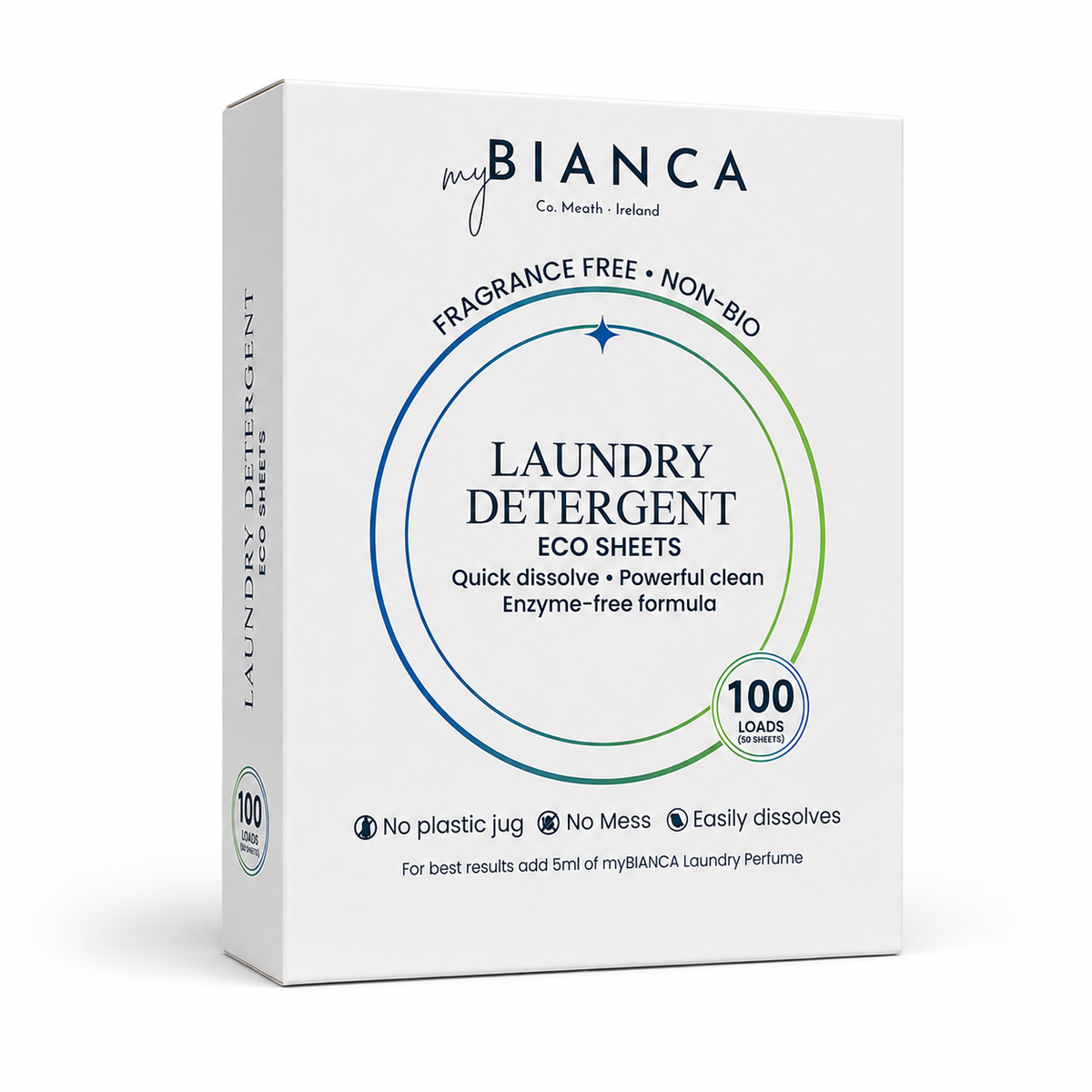
Short answer: Yes, hard water affects your washing. Uisce Éireann says hard water can “reduce the effectiveness of detergents and soaps, meaning you need to use more”, and when it's heated it leaves limescale. Hard water is very common in Irish supplies, so check yours with your Eircode on Uisce Éireann's website. If you're in a hard-water area, the simplest fix is the dose: with myBIANCA detergent sheets, use a full sheet every wash instead of half.
Kettle growing a white crust? Tide marks on the sink? Towels coming out a bit rough? You may well be on hard water. Here's what it does in the wash, how to check your area, and what to change.
What is hard water?
Hard water is water carrying dissolved minerals, mainly calcium and magnesium, picked up as rain soaks through rock and soil. The main source is limestone. As Geological Survey Ireland puts it: “Groundwater hardness arises mainly from the solution of limestone into groundwater.” It isn't a health worry. In Uisce Éireann's words, “Hard water isn't harmful to your health.” It just makes life harder for your kettle, your sink and your washing machine.
Does hard water affect your washing?
Yes, in three ways:
- Your detergent has to work harder. That's Uisce Éireann's point, and Meath County Council, our own local authority, puts it in kitchen terms: it's “more difficult to work up a lather from soap, washing up liquid and washing powders.”
- Clothes can look dull and feel rough. A Journal of Extension paper on laundering in hard water notes that mineral deposits “can cause clothes to appear dingy and become harsh and scratchy to touch”.
- Limescale builds up in the machine. Limescale forms when hard water is heated, and Meath County Council warns that hard water can cause scale to collect “in kettles and in electric irons and washing machines.”
None of that means your washing is doomed. Mostly, it means the dose that's fine in soft water isn't enough in hard water.
How do you know if you have hard water?
- Check your supply. On Uisce Éireann's hard water page, enter your Eircode or address to see what type of water you have in your water supply zone.
- Look for the signs. Limescale in the kettle, tide marks on sinks and baths, and soap that's slow to lather.
- On a private well or a group water scheme? The lookup covers public supplies, so ask your scheme or get your water tested.
Hardness is measured in milligrams of calcium carbonate per litre (mg/l CaCO3). Sligo County Council uses this scale, which it describes as one of several arbitrary classifications:
| Hardness (mg/l CaCO3) | Description |
|---|---|
| Up to 50 | Soft |
| 51–100 | Moderately soft |
| 101–150 | Slightly hard |
| 151–250 | Moderately hard |
| 251–350 | Hard |
| Over 351 | Excessively hard |
It can vary a lot, even within one county. Sligo County Council's own table gives an average of 32 mg/l for the Lough Easkey public supply (soft) and 485 mg/l for Killaraght (excessively hard). That's why it's worth checking your own supply rather than guessing.
What should you change if your water is hard?
- Use the hard-water dose. With myBIANCA detergent sheets, that's a full sheet every wash, not half. A full sheet is also the dose for big or heavily soiled loads. Put the sheet into the empty drum first, then your clothes.
- Don't pack the drum. Clothes need room to move for the detergent to reach them, so split a really big pile into two washes rather than squeezing it all in.
- Don't wash hotter out of habit. Limescale forms when hard water is heated, and our sheets work at every temperature, hot or cold. Save the hot washes for the loads that need them, as their care labels allow.
- Look after the machine. Run its cleaning or maintenance cycle as the manual recommends, and wipe out the drawer and the door seal. Uisce Éireann notes that you can also use water-softening products in your washing machine; if you do, follow the manufacturer's instructions.
One thing to be clear about: detergent sheets don't soften water or remove limescale. The full sheet is simply the right dose for hard water.
What do detergent sheets cost per wash in hard water?
A box of 50 myBIANCA detergent sheets is €19.99. What you pay per wash depends on your dose:
| Your water and load | Dose | Washes per box | Cost per wash |
|---|---|---|---|
| Normal load, water that isn't hard | Half a sheet | Up to 100 | About €0.20 |
| Hard water, or a big or heavily soiled load | One full sheet | 50 | About €0.40 |
So in a hard-water area, plan on 50 washes a box, not 100: still no measuring, no spills and no heavy bottle to carry home. If you add the optional extras, a colour catcher is about €0.26 a sheet (€12.99 for 50) and 5 ml of laundry perfume is about €0.38 a wash (€37.99 for up to 100 washes).
What are the best detergent sheets for hard water?
The honest answer: the ones you dose properly. When you're comparing laundry detergent sheets in Ireland, look for:
- A clear hard-water dose on the pack, not one dose for every load.
- Washes per box at the dose you'll actually use. “Up to 100 washes” means half-sheet washes; in hard water, it's 50.
- Price per wash at your dose, not the best-case figure.
- Where they ship from. Ours are packed and dispatched from Ratoath, Co. Meath.
Our sheets tick each of those: a full-sheet dose for hard water, 50 sheets in a box, about €0.40 a wash at that dose, and packed and dispatched from Co. Meath.
“Love the sheets. I'm always amazed how well they work for such a small sheet.”
Mary B., verified buyer, Laundry Detergent Sheets, October 2026
Where do colour catchers fit?
Colour catchers have nothing to do with water hardness. They're for mixed loads: pop one sheet in the drum when colours and whites go in together, and it helps trap loose dye in the wash water before it settles on other clothes. It can't promise every item will behave, so wash very new or heavily dyed pieces separately and follow the care label.
Do you need laundry perfume in hard water?
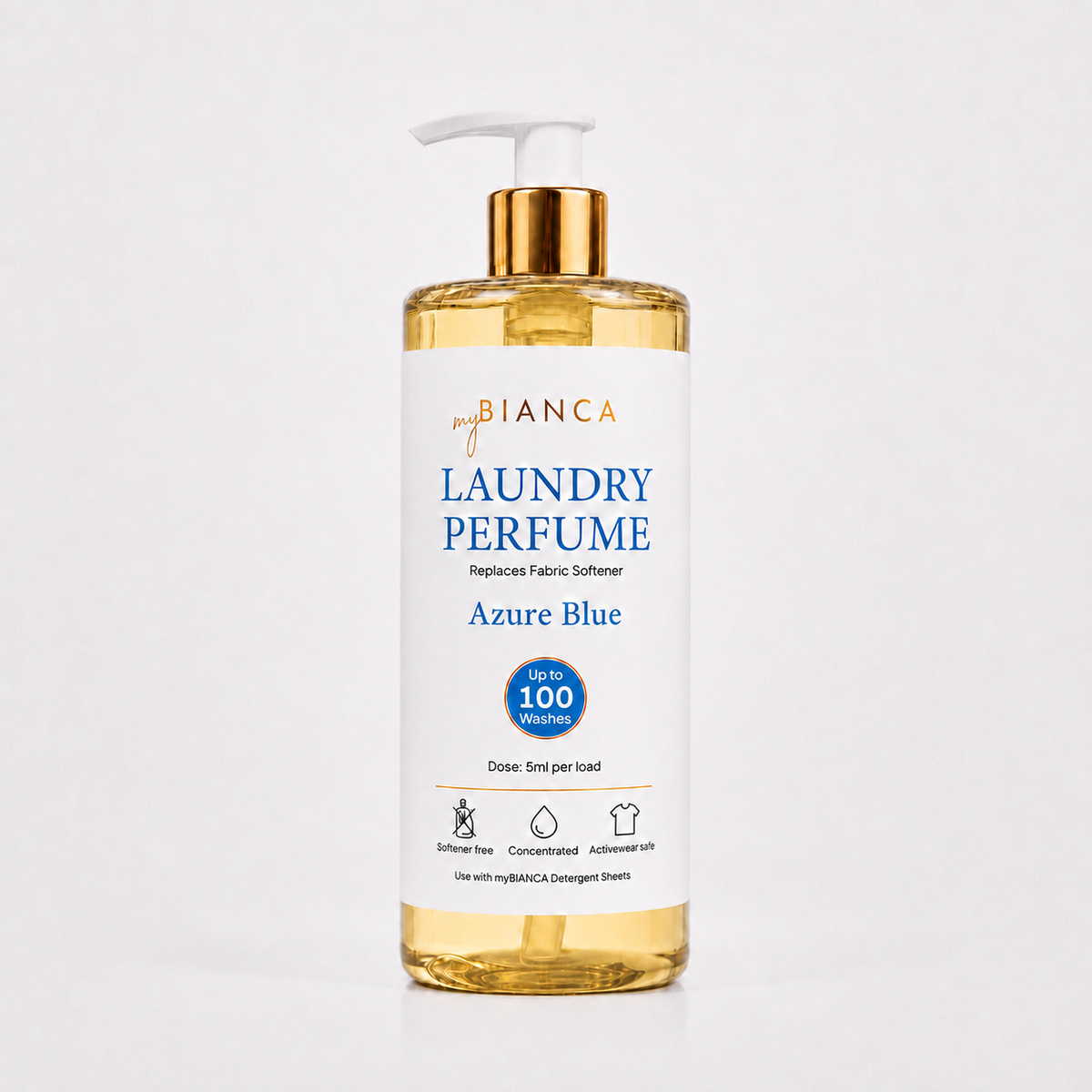
No, it's the optional finishing step. The sheets do the cleaning; if you'd like your washing to smell of something you love, add 5 ml of laundry perfume (five presses of the gold pump) to the fabric-softener compartment. It works with any detergent, at every temperature. And if your washing spends the winter on a clothes horse beside the rads, a scent you love is a lovely thing to walk past.
Try Polar White for towels and whites, or start with the Discovery Bundle: sample sachets of our scents, so you can find your favourite before you choose a bottle. See all six scents, or browse our laundry essentials for the rest of the wash-day kit.
Frequently asked questions
How do I find out if my water is hard in Ireland?
Enter your Eircode or address on Uisce Éireann's hard water page to see the type of water in your supply zone. Limescale in the kettle and soap that's slow to lather are good clues too.
How many detergent sheets should I use in hard water?
One full sheet every wash, instead of half. That's 50 washes from a box.
Is hard water bad for my washing machine?
It can leave limescale: Meath County Council says hard water can cause scale to collect in washing machines. Follow your manual's cleaning advice.
Should I wash at a higher temperature in hard water?
Not out of habit. Limescale forms when hard water is heated, and our sheets work at every temperature.
Do colour catchers help with hard water?
No. They help trap loose dye in mixed loads; they don't change your water.
Sources
- Uisce Éireann, Water Hardness.
- Meath County Council, Information leaflet: Water Hardness.
- Sligo County Council, Hard Water Information Sheet.
- Geological Survey Ireland, Preliminary Groundwater Total Hardness Map.
- Cameron, B. A. (2011). Detergent Considerations for Consumers: Laundering in Hard Water—How Much Extra Detergent Is Required? Journal of Extension, 49(4).
- myBIANCA product pages: detergent sheets, colour catchers and laundry perfume, checked 29 October 2026.
Written by Brendan Arthur, co-founder of myBIANCA, Ratoath, Co. Meath.

Leave a comment
This site is protected by hCaptcha and the hCaptcha Privacy Policy and Terms of Service apply.