

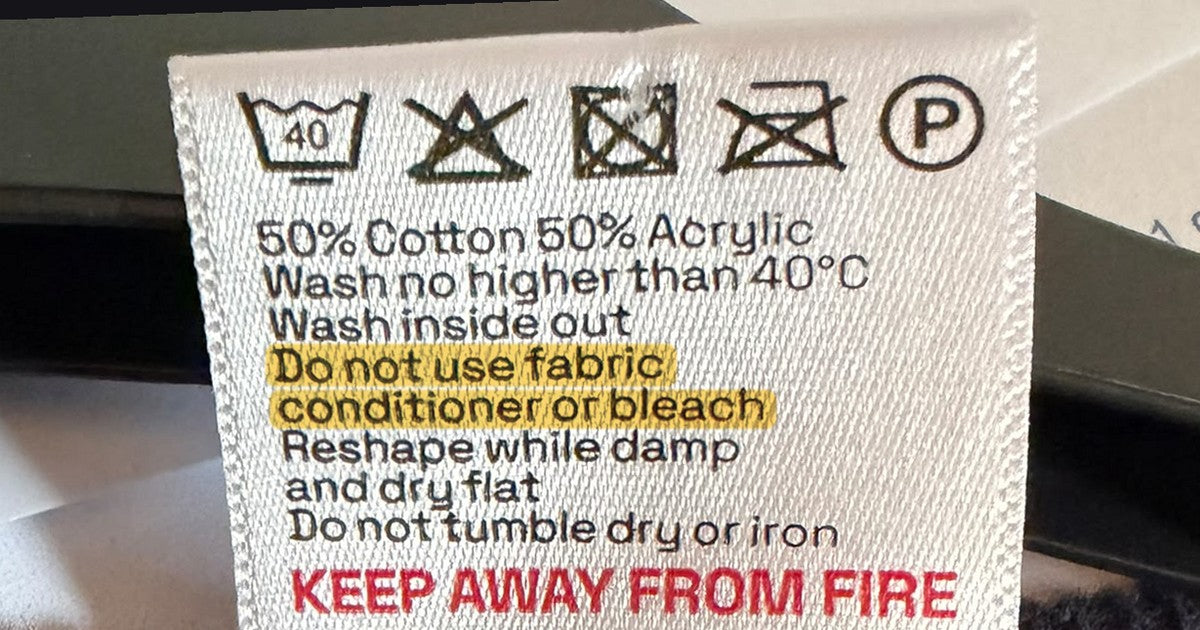
Short answer: the label doesn’t give a reason, but uniform suppliers do: many school garments have a special easy-care coating, and fabric conditioner interferes with it. Softener also works by coating the fibres, and in a 2003 Virginia Tech study, liquid softener made cotton less breathable and made cotton and polyester more flammable, with both effects growing the more often the fabric was washed with it. So for uniforms, PE kit and fleeces, it’s best left out. If it’s the smell you love, you can have that without the softener.
My son started big school at the end of August. When I read the care label on his school jumper, two lines stood out: “Do not use fabric conditioner or bleach.” And at the bottom, in red: “KEEP AWAY FROM FIRE.”
The label doesn’t say why, so I looked into it. Here’s what I found. The sources are listed at the bottom, so you can make up your own mind.
Why does my child’s school uniform say not to use fabric conditioner?
Uniform suppliers give a reason, even though the label doesn’t. One UK school-uniform supplier puts it simply: “We advise not to use fabric conditioner as many garments are specially coated for easy care and fabric conditioner interferes with this process.” Another says it doesn’t recommend fabric conditioner on school uniform at all.
In other words, softener can undo the very finish that makes a uniform easy to look after.
How does fabric softener actually work?
By coating your clothes. McGill University’s Office for Science and Society explains that softeners contain molecules called cationic surfactants, which stick to the fibres and fluff them up. Many softeners also contain silicones, which lubricate the fibres. That coating is what makes fabric feel soft. It’s also behind most of the downsides.
Does fabric softener make clothes more flammable?
This is the one that surprised me most, because the warning is on the softener bottle itself. The back label of a big-name fabric softener on sale in Irish supermarkets says:
“Liquid fabric softener can increase fabric flammability. Using more than recommended can increase this effect.”
The same label says not to use it on children’s sleepwear, on garments labelled as flame resistant, or on garments made with fluffier fabrics such as fleece, velour, chenille and terry cloth.
Lab tests back this up. In a 2003 study at Virginia Tech, cotton and polyester washed with liquid softener became more flammable than fabric washed without it, and the more often they were washed with it, the greater the effect. Dryer sheets didn’t have the same effect in that study.
To keep it in proportion: clothes don’t catch fire on their own, and McGill University’s own summary says the risk of injury from burning clothing is tiny. But it’s an easy risk not to add, especially on fleeces and anything your child sleeps in.
Does fabric softener stop clothes from breathing?
It can make cotton less breathable. In the same Virginia Tech study, liquid softener significantly reduced how much air and moisture could pass through cotton fabric. The effect was on cotton, not polyester. For a school jumper worn all day, between running around the yard at break and sitting in a warm classroom, that’s the opposite of what you want.
Does it get worse the more you wash?
It can. Softener doesn’t just rinse away. In the Virginia Tech tests, cotton let less and less air through the more times it was washed with softener, and flammability went up with repeated washing too. School uniforms get washed a lot.
What else should you skip fabric softener on?
- Fleeces and fluffy fabrics. The big-name softener label we read says not to use it on garments made with fluffier fabrics like fleece, velour, chenille or terry cloth.
- Kids’ pyjamas and nightwear. Same label: not on children’s sleepwear, or on anything labelled flame resistant.
- PE kit and sportswear. Nike’s advice for moisture-wicking shirts is to “skip the fabric softener to preserve performance”, and a UK uniform supplier says conditioner can impair the performance of coated technical sports garments.
- Rain jackets. GORE-TEX’s care guide says not to use fabric softeners.
- Towels. Softener reduces how absorbent fabric is, and absorbing is the one job a towel has. Towel maker Christy advises against it.
What does “Keep away from fire” on a child’s label mean?
It’s a standard label, not a special warning about your child’s jumper. The HSE explains that children’s nightwear must meet Irish safety standards (look for “low flammability to I.S. 148” on the label), and clothes that don’t meet that standard carry “Keep away from fire” in red capitals. That’s normal for everyday clothes. But it’s one more reason not to add a product whose own bottle says it can increase fabric flammability.
What to do before the next school wash
- Check the labels on uniforms, PE kit, fleeces and pyjamas.
- Leave out the softener on anything that says so, and on fleece, sportswear, towels and nightwear.
- If you do use softener on other washes, stick to the dose on the bottle. The label itself says using more than recommended can increase the flammability effect.
- Clean the softener drawer now and then, whatever you use. Miele notes that detergent and softener can build up there and leave an unpleasant smell.
Know a parent washing a school uniform tonight? Send them this.
How do I keep the fresh smell without softener?
This is exactly why we made myBIANCA. It’s a laundry perfume: 5 ml of concentrated fragrance in the softener drawer, in place of softener. There are no softening agents and no silicone in it, so you get the lovely smell without the softener. It says it on our label: Replaces Fabric Softener.
One honest note: I’m not claiming myBIANCA makes clothes safer. It simply isn’t a softener. For children’s nightwear or anything labelled flame resistant, always follow the care label.
500 ml bottles are €37.99 (up to 100 washes), or pick any three 50 ml Home Minis for €24.99. New to myBIANCA? Try four scents for €19.99 on your first order, delivered free.
Frequently asked questions
Are dryer sheets better than liquid softener?
In the Virginia Tech study, dryer sheets didn’t make fabric more flammable, but they still reduced how much moisture could get through cotton.
Can I use fabric softener on kids’ pyjamas?
The softener label we read says not to use it on children’s sleepwear or on anything labelled flame resistant. Always follow the garment’s own care label.
Does using less softener help?
The label says using more than recommended can increase the flammability effect, so if you do use it, stick to the dose on the bottle.
Is fabric softener bad for towels?
It reduces absorbency, so towels don’t dry you as well. Towel maker Christy advises against using it.
Is laundry perfume the same as fabric softener?
No. myBIANCA adds fragrance and isn’t a softener. It goes in the softener drawer instead of softener.
Sources
- Back label of a big-name fabric softener on sale in Irish supermarkets, checked 30 September 2026.
- Guo, J. (2003). The Effects of Household Fabric Softeners on the Thermal Comfort and Flammability of Cotton and Polyester Fabrics. Virginia Tech.
- Schwarcz, J. (2003). Fabric softeners and flammability. McGill University Office for Science and Society.
- HSE. Clothes safety for babies and children.
- School Bells, Garment care, and Schoolwear Plus, Garment care.
- Nike. Moisture-wicking fabric, explained.
- GORE-TEX. Outerwear care instructions.
- Christy. How to wash towels.
- Miele. Eliminating bad odors from your washing machine.
- “Fabric softener”, Wikipedia, citing Ullmann’s Encyclopedia of Industrial Chemistry (how softeners work, and absorbency).
Written by Brendan Arthur, co-founder of myBIANCA, a laundry fragrance brand based in Co. Meath.


Leave a comment
This site is protected by hCaptcha and the hCaptcha Privacy Policy and Terms of Service apply.